Come on in, sit a spell, and let me tell you about my life in the country. If you enjoy what you read, please follow my blog and share with your friends! My book, Turn by the Red Calf, a collection of my posts, is available on Amazon in paperback and Kindle edition.
Showing posts with label ancestors. Show all posts

Monday, February 21, 2022

Turn By the Red Calf


I have read funny stories, some probably true and some apocryphal, about giving directions in the South.   My childhood friends and I laugh at some of the things we say – like turn where Pickard’s Store used to be.  Pickard’s store has been gone for at least fifty years now, but in my mind, it is still an important landmark.  What else are you going to use, since there’s basically nothing else there to point to?  If someone in the conversation looks confused, we have to tell them the story about Pickard's store, explaining that it was Chessor’s Store before that, and the school bus used to stop there sometimes and let the bus riders off to get a candy bar or coke on our way home from school.  I can still remember the suspense and anticipation as we neared the store.  Would the driver pull in today or would he sail on by, leaving us deflated?  It was a much more innocent time, and it probably was one of the reasons we had very little disciplinary problem on our bus.  No one wanted to be the reason we didn’t get to stop at the store.

Sunday afternoon, I found myself uttering a directive that was the epitome of the cliché that is Southern direction-giving.  “Turn at that red calf,” I directed, from the back seat of an all-wheel drive Saturn.  The designated calf was watching the progress of our vehicle as we made our way along what used to be a road of sorts.  I was the only one who knew about the road, and it probably didn’t matter if we were on it or not, so long as we didn’t get too close to one of the gullies that ran down the hill.

We were metal detecting, a new adventure for me.  Friends of mine are enthusiasts, one an expert who has discovered historical artifacts around the area and the other his pupil, a history-loving beginner.  The attractions in my pasture were the remains of an 1850’s log cabin and a tumble-down 1920’s frame house.  Sophie and Bear accompanied us, trotting along behind.  I had left Scout in the house.  I don’t think he could tear up or steal a metal detector, but I wasn’t going to take any chances.

Back of the log cabin

I told my audience about the cabin and about my great-great grandfather who built it before he went off to fight in the Civil War and raised a large family in it before building the house I live in now in the mid 1870’s.  As we looked inside, I marveled again at where they all slept and ate.  I’ve always figured it had an additional room at one time, but if it did, my granddaddy didn’t remember it.  He did share the story with me of my great-great grandmother, Lucinda, who hid her horse from the Yankees in a crevice between two rocks down behind the cabin.   

Lucinda's hiding place

I wrote a short story about the incident when I first started seriously writing for magazines.  I believe it was about the second or third story I sold.  “Save Raven” was the title and I made two of the younger children the heroes who kept the family horse safe.  Somehow I lost my copies of the story down through the years and the magazine no longer exists.  I wish I had it; I think it was a pretty good story.

I made a few passes with the metal detector, but mostly I walked around and looked at the scenery.  The cabin was built on a hill, with a view of the bottom land and the trees that line the river.  The hills across the river stretch west and a few buildings dot the landscape over there.  When I was a child, there was not a building in sight. I would love to have a house there.  I pointed out the steep hill behind the cabin where the family most likely got spring water and we speculated on where the garden might have been.  We didn’t find anything of real interest buried around the site, other than some abandoned machinery that trees had grown into and a small piece of an old iron stove.  Sophie got bored and went home and Bear occupied himself looking for something to chase.  The cows, as cows do, gathered nearby to watch intently, wondering what the humans were doing and what those weird noises were from the sticks they were waving across the grass.
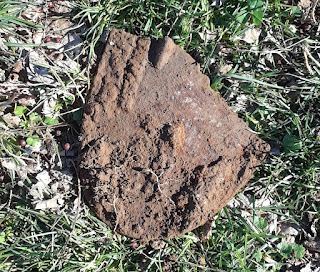
Fragment of old iron stove

It was when we decided to move down the hill to the other little house that had been built for farm workers that the red calf became a signpost.  When my family was still working the farm, they had a pretty decent road that led down and past the house on the way to the bottom, but it had long since disappeared from view.  The house was fairly intact back then, but now much of the floor has fallen in, the porch is gone, the steps are broken and I would not dare go inside what is left.  We did salvage some ceramic doorknobs from there when I started renovations on the farmhouse and there might be some old doors worth saving still.  It’s a sad sight, with faded, peeling wallpaper and sagging doors.

It was at this spot that Mandy made the find of the day, a saltshaker buried about four inches in the ground.  How it ended up there is a mystery never to be solved.  Bear flushed what may have been a coyote and I had to call him out from under the house several times in his quest for something I would rather not know about. I pointed out the sledding hill we used when I was young and dumb enough to dodge briars and frozen cow piles during infrequent snows.  We called it a day when the sun dropped behind the trees by the forlorn little house.  Sophie greeted us back at the house, offering everyone her paw as if to apologize for deserting us.  Treasure hunting, it seems, is just not her cup of tea.

Saturday, August 7, 2021

Where I Come From


I don’t remember much about my great grandmother, Kizzie Frazier Shouse.  We lived in same house until I was around 8 years old and she died when I was in the fourth grade.  My memories of her are vague, and her health was not good in those memories.  But I owe her a great debt because she was the one who gave me so much of my history.  Thanks to her, I was able to get a good sense of where I come from.  In the south, when we introduce someone, we tend to give a synopsis of that person's ancestry.  I read once that the reason for that is that we like to know WHO they are.

Miss Kizzie, as we called her, saved everything.  Letters, cards, calendars, pictures, mementos of all kinds – all were stored in her rooms, waiting discovery after she was gone.  I wasn’t so much interested as a child, but by the time I was a teen, I was fascinated by my history.  And, thanks to her, it was there, waiting for me.  Pictures, letters, clippings, family Bibles, handwritten notes about various ancestors – a treasure trove for a history lover.  I read about her courtship with my great grandfather, her life as a farm wife, caring for her chickens and selling the eggs, and, with tears in my eyes, her beloved husband’s final days and his death.  It was strange to think of the frail old lady I remembered as a beautiful young wife and then as a grieving widow.   She was 70 when her Jimmy died, and she received at least three proposals of marriage afterward.  I know that because she kept the letters, with the names of her suitors carefully torn off!

Kizzie’s mother, Millie, is one of my heroes.  She first married Joseph Garrett, and early in their marriage, they moved from Hickman County to Arkansas. It was an arduous journey of almost two months to unsettled country.  No railroad, no telegraph, only the crudest roads and many rivers, including two major ones, to cross.  After only being there a short time, Joseph died.  She was left in a strange area with a baby.  Now, I might have been tempted to sit down and spend the next year crying and listening to my baby cry.  Not Millie.  She found a family traveling back to Tennessee, mounted her horse, took her baby up on her lap and made the perilous trip back to her family in Hickman County, riding by day and camping with the family at night.  After the Civil War, she married my great-great grandfather, William Frazier, who was, I expect, quite a dashing figure.  At least his pictures as an older man showed a handsome erect man with a full beard.  Together they raised, not only the baby from her unfortunate first husband, but their own three girls and two boys.  I have often pondered her life and her courage.  If she had been less brave, I wouldn’t be here.

I continue to make discoveries about William.  One of the treasures my great grandmother preserved is a battered little diary from his time in Camp Cheatham during the early days of his service in 11th infantry.  It begins with these words: “On Thursday the 25th of April, I said my last paragraph in Caesar and retiring from my studies on Friday the 26th I enlisted as a private in Captain Bateman’s company of light infantry. “ After a bout with fever and a recovery at home, he joined the cavalry and served until the end of the war.  His horse was shot and killed under him during the Battle of Nashville.  Just before the Battle of Franklin, a bullet shattered the hilt of his sword, injuring neither his horse nor him.  Another incident that took place involved a near disaster during a ferry crossing on the Tennessee River near Perryville.  When the ferry sank, everyone except one man managed to make it to the bank.  When William realized that the man could not swim, he swam out to him and pulled him to the bank using a cedar rail.  The two men met by coincidence many years later at a meeting at Liberty Church and recalled the incident. 

The handwriting is beautiful, but cramped and hard to read.  The book is only about the size of a pack of cigarettes and half as thick.  A couple years ago, I finally decided to transcribe the diary.  I discovered, not only a dashing soldier, but a young man with a poet’s soul.  I like to think my writer’s ability came from him and from his daughter Kizzie.  Reading this tiny book gave me a sense of who William was, and it also changed my view of the Civil War.  Even in the first months of his enlistment, before he saw an enemy soldier, he watched several friends die of disease, waded mud that threatened tents and kept clothing wet for days at a time.  He writes about missing his family and tells of a heart wrenching moment when friends in the camp hospital gave him their possessions for safekeeping in case they did not survive their illness.  But he also wrote about the beauty of a spot by the river, shade trees and blue skies and the music of the birds.  Did he have any idea what was ahead as he described the sight of uniformed soldiers drilling?  “The sun was shining brilliantly, their Minnie rifles and bayonets as bright as a dollar glittered in the sunshine as they advanced to and fro.”  I hope not.  I wonder if he re-read his words later in life and realized what a senseless tragedy it was.

Recently, a new chapter, for me, was discovered in the life of William Frazier.  As I said, I have had his diary in my possession since the death of my great grandmother.  Imagine my surprise when the president of the historical society, where I am a volunteer, called me and said that a friend had sent him a transcribed copy of William Frazier’s Civil War diary, which he had obtained from the University of Memphis.  “It’s never been out of our house to my knowledge,” I told him.  “Well,” he said, “maybe it’s another diary.”  Turns out it is another diary, which picks up right where mine leaves off, with his regiment boarding the train in Nashville in July, 1861.  I have no idea how it ended up at the University of Memphis.  Is there another one out there somewhere?  I wish I knew.

William, Millie and Kizzie Frazier